

Track: Quantum Computing | Type: Insight | Reading Time: 9–11 min
The quantum computing industry has arrived at a critical juncture: the center of gravity is moving from speculative research toward rigorous systems engineering. For years, the sector’s reputation oscillated between breathtaking promise and stubborn hardware limits. That divergence is physics: qubits are fragile, noise is relentless, and the gap between a toy computation and a commercially useful system is not incremental — it’s a chasm defined by error rates.
By 2026, the industry consensus has hardened into a single thesis: quantum computing becomes useful not when it exists, but only when errors stop winning. Quantum error correction (QEC) is no longer an academic side quest. It is the bottleneck, and it is the most honest measure of progress toward fault tolerance.
“A quantum computer is not useful when it exists. It’s useful when errors stop winning.”
In the last two years, the narrative has shifted away from “headline demos” toward logical-qubit stability and the reduction of overhead. Google has demonstrated below-threshold surface-code behavior on its Willow processors, showing error rates improve as the code distance increases. IBM has published a roadmap explicitly targeting fault-tolerant modules and scaling to hundreds of logical qubits. And Microsoft continues to pursue a high-risk approach built around topological hardware, framing it as a path toward stability at scale.
The Physics of Fragility and the Error-Correction Bottleneck
The obstacle is the environment.
Unlike classical bits — which can be represented robustly by voltage levels — qubits rely on delicate quantum states such as superposition and entanglement. Those states are easily disrupted by thermal noise, electromagnetic interference, imperfect control pulses, and stray interactions with the surrounding world.
In practice, every gate operation, measurement, and idle period introduces error probability. Left unmanaged, those errors accumulate across circuit depth until the output becomes indistinguishable from noise.
QEC is the engineering response: encode quantum information across many physical qubits, detect errors through syndrome measurements, and apply corrections fast enough that computation stays on track.
Translating Capabilities: Physical vs. Logical Qubits
Most public claims in quantum still emphasize physical qubits — because they are easy to count. But the metric that determines commercial utility is logical qubits: corrected units that can hold state and execute operations reliably enough to run deep circuits.
| Metric | Physical Qubits | Logical Qubits |
|---|---|---|
| Definition | Individual, noisy hardware units (e.g., superconducting circuits, ions, atoms, photons). | Encoded units formed by groups of physical qubits to resist errors. |
| Market signal | Signals manufacturing scale, ambition, and raw hardware progress. | Signals capability, engineering maturity, and algorithmic stability. |
| Typical error rate | Commonly discussed in the ~10^-2 to 10^-4 range per gate (hardware-dependent). | Targeted far lower for commercial workloads; depends on code and application requirements. |
| Utility | Useful for experiments, benchmarking, and error-mitigation studies. | Required for deep circuits: chemistry simulation, cryptography, optimization, and industrial workloads. |
“Physical qubits are marketing. Logical qubits are capability.”
Architectural Shifts: From Surface Codes to qLDPC
For nearly a decade, surface codes dominated roadmaps because they tolerate relatively high physical error rates and align with 2D nearest-neighbor layouts. The problem is overhead: surface-code fault tolerance can demand very large physical-to-logical ratios.
That overhead is why the conversation in 2026 is shifting toward quantum low-density parity check (qLDPC) codes and architectures that can support more efficient encoding. IBM, for example, has publicly described a fault-tolerant path where qLDPC codes play a central role in reducing overhead and enabling modular scaling to systems like Starling.
This matters because the commercial race is no longer “who has the most qubits,” but “who can run the most logical operations before error accumulates.”
The Roadmaps: What “Real Progress” Looks Like
Three institutions capture the new posture of the industry — each in a different way.
IBM: the systematic scaling path IBM has laid out a detailed roadmap culminating in “Starling,” targeting a system capable of running 100 million logical gates on 200 logical qubits by 2029 — a statement that explicitly anchors progress in logical performance, not physical counts.
Google: below-threshold becomes measurable Google’s Willow work demonstrated below-threshold surface-code operation: increasing code distance yields better logical performance, validating the engineering direction QEC requires.
Microsoft: topological ambition Microsoft introduced “Majorana 1” as a processor powered by topological qubits and a “topoconductor” material approach, positioning it as a path to stability. Whether topological architectures reach scale quickly or not, the strategic point remains: stability and fault tolerance are the game.
The Hidden Constraint: Real-Time Decoding
A major realization in 2025 is that QEC is increasingly constrained by classical systems.
Error correction requires a fast classical loop to interpret syndrome data and decide corrections before qubits decohere. For some modalities, this loop must run at extreme speeds. The quantum system is only as fault-tolerant as the entire closed-loop stack: control electronics, decoding, feedback, and timing.
The implication is uncomfortable but clarifying: quantum advantage is no longer only a quantum engineering problem — it’s a full-stack systems engineering problem.
A Practical Framework: The QEC Capability Checklist (2026)
For investors, editors, and decision-makers trying to separate engineering reality from marketing, use this filter:
- Logical break-even: Does the system demonstrate logical states that outperform the underlying physical qubits over time?
- Overhead trajectory: Does the roadmap show a credible path to reducing physical-to-logical overhead (surface code or qLDPC-based)?
- Real-time syndrome loop: Is the classical decoding loop fast enough for the modality’s coherence limits?
- Fault-tolerant operations: Are logical operations being performed while active error correction is running?
- Modularity and scaling: Is there a credible path beyond a single device (module-to-module connectivity)?
“The quantum race is now an engineering race: control loops, error budgets, and reliability per operation.”
What This Means
For investors: QEC is the primary filter for quantum hype. The durable winners are the teams who can reduce overhead, increase logical performance, and build reliable modular systems — plus the supply chain that enables them (control electronics, cryogenic infrastructure, decoding hardware, and verification tooling).
For national security and compliance: progress in fault tolerance tightens the logic behind “harvest now, decrypt later” risk. Post-quantum migration is not just a future plan — it is a parallel program that must run while fault tolerance matures.
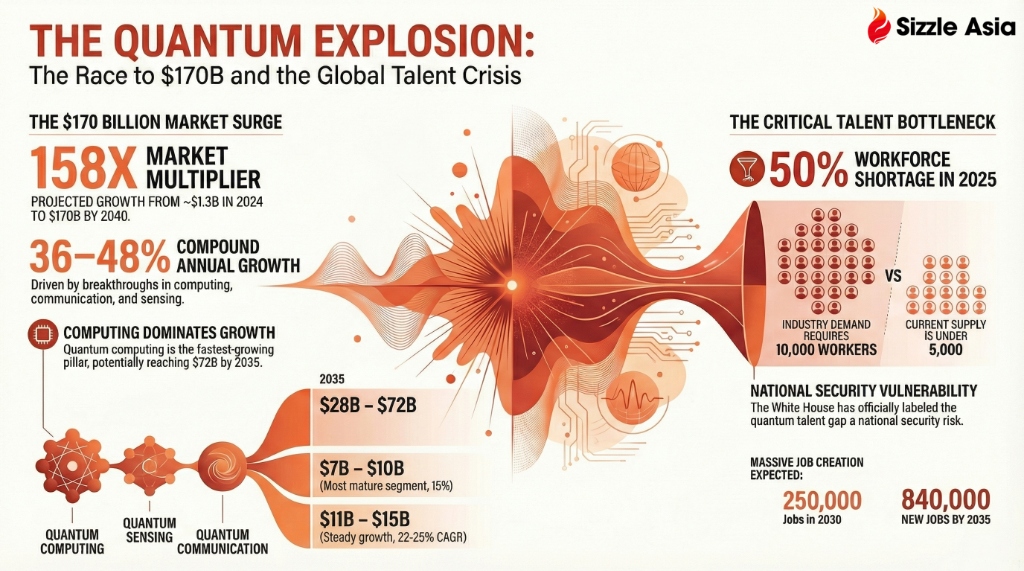
Infographic — The quantum market’s 158× multiplier, the $170B trajectory, and the critical talent bottleneck shaping the QEC race.
Conclusion: 2026 Belongs to the Builders
The industry has entered the engineering ascendancy. The scoreboard is changing.
In 2026, the only metric that matters for commercial utility is the ability to keep computation coherent long enough to do something real — and that means error correction, not headlines.