


Track: Quantum Computing | Type: Insight | Reading Time: 8–10 min
The End of the “Wait and See” Era
For the better part of a decade, the threat of quantum computing breaking modern encryption was treated as a physics problem — distant, theoretical, and comfortably academic. That luxury of distance has evaporated.
In 2026, Post-Quantum Cryptography (PQC) has mutated from a research topic into a procurement mandate.
Two milestones collapsed the timeline.
First, in August 2024, NIST finalized its first three primary post-quantum standards: FIPS 203 (ML-KEM), FIPS 204 (ML-DSA), and FIPS 205 (SLH-DSA). Second, CNSA 2.0 sets a hard procurement cliff: by January 1, 2027, all new acquisitions for National Security Systems must mandate quantum-resistant algorithms.
With less than twelve months to that cliff, 2026 is no longer about understanding the math. It is the year of inventory, architecture, and execution.
“The question isn’t whether quantum computers will break encryption — it’s whether your organization will be protected when they do.”
The Immediate Threat: Harvest Now, Decrypt Later
The urgency is not driven by a fault-tolerant quantum computer existing today. It is driven by the shelf-life of secrets.
This is the logic of “Harvest Now, Decrypt Later” (HNDL): adversaries exfiltrate and store encrypted data now, with the expectation that future capability will make it readable later. If a dataset needs confidentiality for 10–20 years, relying on RSA or ECC alone today becomes a retroactive risk: data stolen in 2026 could be readable in the early 2030s.
This is why PQC has moved from “future planning” to “present mitigation.” The threat is not only forward-looking — it is backward-looking.
The 2026 PQC Execution Checklist
Migration is not a patch. It’s an infrastructure refactor.
In 2026, the practical win is not perfection — it is reducing time-to-quantum-safety by executing the work in the right order:
-
Establish a Cryptographic Bill of Materials (CBOM) You cannot migrate what you cannot see. Inventory every cryptographic dependency: TLS endpoints, certificates, VPNs, code signing, HSM usage, embedded firmware, third-party SDKs, and libraries.
-
Prioritize long-secret data Identify datasets that must remain confidential past 2030 (regulated records, identity data, IP, strategic communications). These should be first-movers into hybrid or PQC-capable designs.
-
Implement hybrid protocols in high-value pathways Many teams begin by deploying hybrid key exchange on critical paths to preserve classical assurance while adding quantum-resilient primitives (the point is resilience, not ideology).
-
Audit the supply chain against deadlines CNSA 2.0 doesn’t only apply to your code — it applies to your dependencies. If your SaaS providers, VPN stack, PKI vendor, or firmware pipeline has no PQC roadmap, that is a 2026 procurement risk.
The Regulatory Vise: Compliance Tiers
CNSA 2.0 is the sharpest procurement trigger — but it is not the only pressure.
The pattern emerging in 2026 looks like this:
- Government / defense-adjacent supply chains face hard acquisition requirements first.
- Finance and critical infrastructure are pushed by supervisory roadmaps and long-secret data exposure.
- Everyone else is pulled by procurement: if your buyers must comply, your product must comply.
“Legacy systems are the Achilles’ heel of quantum readiness — because crypto is often hardcoded where nobody wants to touch it.”
What This Means
For CTOs, the era of “set and forget” encryption is over. The objective is crypto-agility: the ability to swap algorithms without rewriting the world. Hardcoded cryptographic decisions are now technical debt with a deadline.
For investors, durable value may not be in algorithms alone — it’s in tooling: automated discovery, inventory management, migration orchestration, certificate lifecycle systems, and crypto-agile platforms that reduce execution risk.
For product leaders, “quantum readiness” is turning into a go-to-market constraint. By 2027, “we don’t support PQC yet” will increasingly read as “we can’t sell into your regulated stack.”
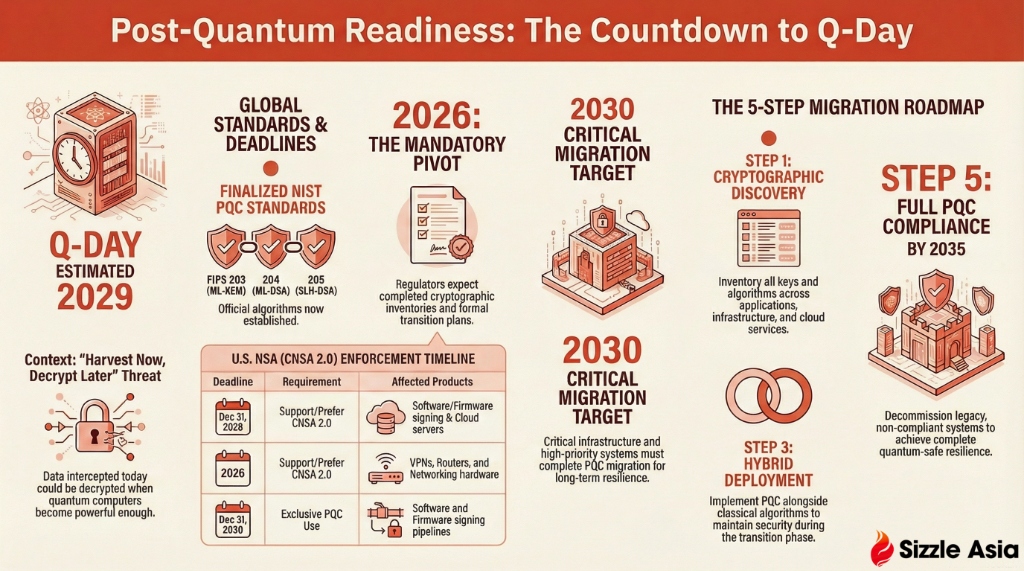
Infographic — PQC migration is an execution program: inventory (CBOM) → prioritize long-secret data → deploy hybrids on critical paths → enforce vendor readiness.
Conclusion: The Compliance Clock Starts Now
2026 is the transition year where quantum risk stops being a future discussion and becomes an execution program.
The organizations that win won’t be the ones with the best slide deck on quantum. They’ll be the ones who build crypto-agility, map their cryptographic surface area, and start migrating the places where harvest-now-decrypt-later risk is already real.