


Track: Blockchain | Type: Insight | Reading Time: 8–10 min
The global financial system is navigating a transition from legacy book-entry accounting to programmable, distributed ledger environments. The public narrative has often focused on spectacle — fractional ownership, retail speculation, meme-level liquidity. The institutional reality is quieter and more demanding: tokenization is governance, settlement design, and custody resilience.
Tokenization is no longer a branding exercise. It is a decision framework about three things: what becomes the record of ownership, who is authorized to transfer it, and how cash and assets settle without creating new risk. If those foundations are not explicitly defined, the “digital asset” remains a story rather than a robust instrument.
The Engineering of the “Cash Gap”
Institutional markets are built on finality: the moment a transfer becomes irrevocable.
A recurring failure point in early tokenization pilots was the decoupling of asset transfer from payment. In 2023, Siemens issued a €60 million digital bond on a public blockchain — but the payment leg still moved via traditional bank transfer, creating a cash gap where the asset could settle faster than the money.
This friction is why institutional tokenization is converging on atomic settlement — where the asset and payment move together (DvP/PvP) instead of arriving on different timelines.
Three practical approaches have emerged for the payment leg:
-
Tokenized deposits Representations of commercial bank money on-ledger, issued by regulated banks and backed by deposits — designed to fit existing banking law.
-
Wholesale CBDCs Tokenized central bank reserves for interbank settlement, offering central-bank-grade safety.
-
Regulated stablecoins Fiat-pegged tokens governed by emerging regulatory regimes, often used for cross-venue liquidity and cross-chain movement.
“The promise of tokenization is speed. The price of tokenization is governance.”
This is not theoretical. J.P. Morgan’s Kinexys platform (formerly Onyx) highlights what “regulated value movement” looks like at scale, noting average daily transaction volumes above $2 billion and large notional volumes since inception.
The Legal Wrapper: Why Code Is Not Law
The most common failure mode in tokenization is conflating the token with the asset.
Tokenizing an asset is not identical to tokenizing the rights associated with the asset. Before a single line of code is written, an institution must define what the token represents:
- ownership
- a legal claim
- a receipt
- an entitlement
- or a contractual right against an SPV or issuer
This distinction determines everything downstream: enforceability in insolvency, transfer restrictions, investor protections, and custody obligations.
Practical structuring models institutions use:
- Security tokens — rights in regulated financial instruments (shares, bonds).
- Tokenized funds — fund units recorded on a DLT registry (with conventional fund wrappers).
- Hybrid models — an SPV holds the off-chain asset; the token represents a claim on the SPV.
If the legal wrapper does not explicitly bind the on-chain token to the off-chain reality, the chain of title breaks — and the token can become legally fragile precisely when stress arrives.
The Standard Wars: ERC-3643 and Identity
The institutional future of tokenization is not anonymous.
To satisfy KYC/AML, sanctions, and eligibility rules, tokens must be compliance-aware — enforced at transfer time, not bolted on in reporting. That requirement is why standards like ERC-3643 have become important in regulated token designs: they are built around identity and policy enforcement rather than free transfer by default.
A typical ERC-3643 pattern includes:
- Identity registry — references verified identities.
- Compliance module — encodes transfer rules (lock-ups, eligibility, jurisdiction rules).
- Token contract — remains interoperable at a standards level, while gating transfers through compliance logic.
The institutional point is simple: long-dated assets (bonds, funds, real estate) require rules that can evolve without breaking the instrument.
Interoperability as the Strategic Moat
A token that exists in a silo is a dead end.
Tokenization becomes infrastructure only when it integrates with settlement systems, reporting workflows, and multi-network environments — and when it can move without losing compliance metadata.
That is why interoperability efforts are accelerating. SWIFT has announced plans to add a blockchain-based shared ledger to its infrastructure stack, combining a shared ledger with existing messaging and ISO 20022 rails to enable real-time, always-on cross-border flows with embedded controls.
And this is why “middleware” matters: the connective tissue that moves data and value across chains, institutions, and legacy systems without breaking auditability.
“This is an infrastructure story, not a crypto story.”
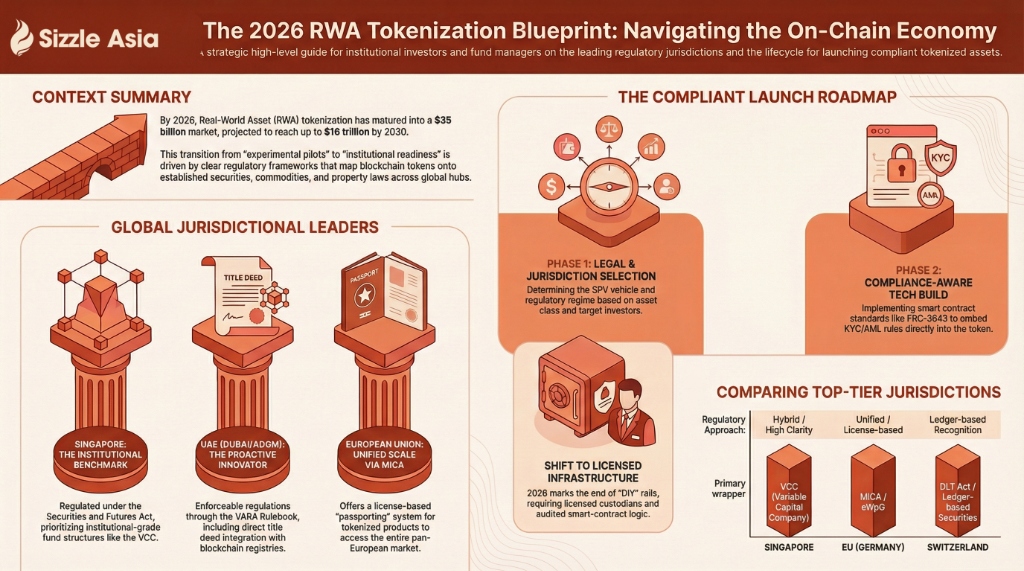
Infographic — Institutional-grade tokenization requires legal clarity, on-chain or tightly coupled cash settlement, compliance-aware identity, resilient custody, and interoperability across systems.
What This Means
Tokenization is entering its mature phase. The public narrative may remain loud, but the real progress is technical and institutional: standards, risk frameworks, custody design, and settlement mechanics.
For investors, the opportunity is shifting. The alpha is not in finding a new asset class to tokenize. The alpha is in infrastructure: custody resilience, compliance standards, settlement rails, and interoperability layers that become unavoidable toll gates.
For editors and journalists, the angle is clean: the transition from theater to plumbing is underway. Tokenization is not about inventing new assets — it’s about making existing assets move faster, safer, and cheaper, without breaking the legal and operational foundations finance depends on.
The Institutional Deployment Stack
If a tokenization project claims to be “institutional-grade,” it should be able to answer these five questions:
-
Legal clarity Does the token represent a legally enforceable claim (issuer, SPV, registry, custodian)?
-
Settlement finality Is the payment leg on-ledger (tokenized deposits / regulated cash leg), or is there still a cash gap?
-
Identity standard Does the system enforce eligibility and compliance at transfer time?
-
Custody resilience Is key management operationally hardened (eliminating single points of failure and supporting recovery)?
-
Interoperability Can the asset move across venues without losing compliance metadata, auditability, or legal certainty?