

Track: Artificial Intelligence | Type: Insight | Reading Time: 7–9 min
The arrival of 2026 has marked a structural rupture in enterprise technology. As AI transitions from episodic chatbots to autonomous agentic systems, organizations are running into a hard constraint: continuous inference is not just a software problem — it is an infrastructure problem.
The primary challenge for CIOs and CTOs has shifted from model selection to managing the volatility of always-on reasoning loops: capacity, cost, and reliability under steady-state load.
This guide explores the architectural "Great Rebuild" required to survive the shift, detailing the infrastructure patterns, cost-control planes, and reliability mechanisms needed for production-grade Agentic AI.
The Mathematics of the Inference Explosion
In the previous SaaS generation, compute consumption followed human diurnal patterns: active in the day, quiet at night. Agentic AI inverts that model.
Autonomous agents operate in continuous loops. They maintain context across days, execute multi-step workflows, retry tasks without human intervention, and keep re-checking the world until they are confident enough to act. Value is no longer created primarily during training, but during the constant execution of real-world processes.
The shock comes from a verification multiplier. An agent does not simply answer a question; it plans, acts, verifies, retries, and verifies again. This creates tool-call inflation, where a single objective spirals into a cascade of read–reason–verify operations.
Even as per-token costs have fallen dramatically, total enterprise spending can rise because usage outpaces unit-cost reductions by orders of magnitude. In 2026, inference behaves less like "API calls" and more like a utility meter.
The New Architecture Stack: Strategic Hybrid Compute
Organizations are discovering that cloud-first strategies built for agile web applications can become financially unstable for high-volume, steady-state inference. The "easy button" of public cloud APIs works for pilots, but becomes costly when autonomy turns inference into a 24/7 base load.
Leading teams are adopting a three-tier hybrid architecture optimized for inference economics:
- Public Cloud (Elasticity): Reserved for experimentation, variable training workloads, and burst inference where agility outweighs cost.
- Private Cloud / On-Prem (Consistency): The new home for high-volume production inference. For predictable workloads, controlled capacity can become the fiscally responsible choice.
- Edge Computing (Immediacy): Essential for time-critical decisions in manufacturing, robotics, and healthcare where round-trip latency is unacceptable.
This physical architecture is enabling the rise of "AI factories" — purpose-built environments integrating accelerated compute, high-bandwidth memory, and optimized networking designed for the thermal and throughput realities of continuous inference.
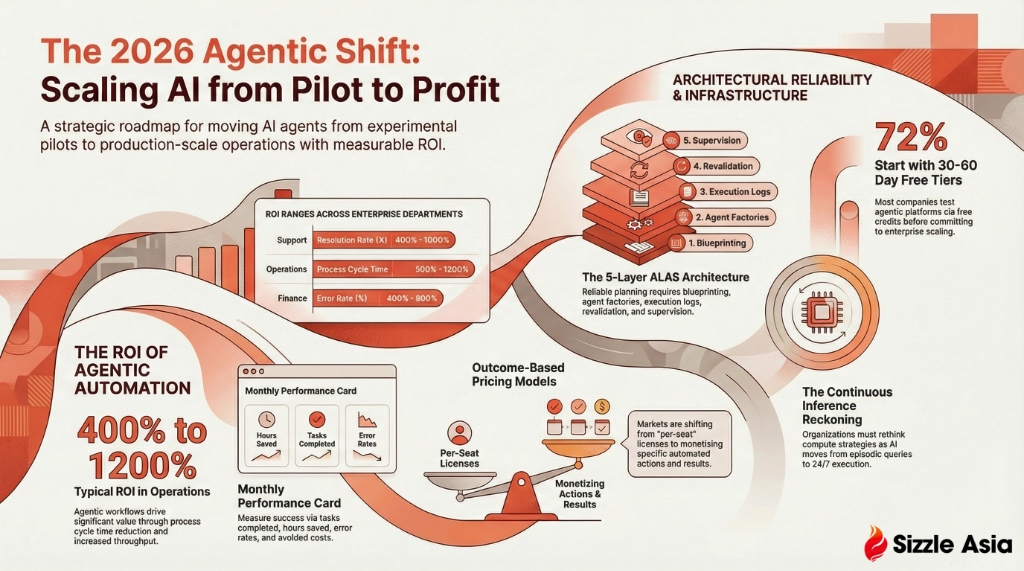
Infographic — Hybrid compute for continuous inference: elasticity (cloud) → consistency (private/on-prem) → immediacy (edge).
The Cost Control Plane: Agentic FinOps
Because agents behave like living workflows that can spin out of control, traditional FinOps is insufficient. Enterprises need a Cost Control Plane — a runtime layer that enforces budget awareness and throttling inside the agent's logic.
To manage the autonomy cost stack, architects are pulling four primary levers:
- Model Tiering (Smart Routing): Route routine steps to smaller, faster models while reserving premium reasoning models for high-stakes decisions.
- Runtime Budget Ceilings: Budgets must be constraints, not retroactive reports. If an agent hits a cap or enters a retry storm, the system must throttle, degrade, or kill the process.
- Tool-Rate Limiting: Retry discipline (exponential backoff, circuit breakers) prevents agents from burning cash during downstream outages.
- Verification Architectures: Use cheaper models to draft and larger models to verify. Done correctly, this can reduce costs materially with minimal quality loss.
"Agentic AI turns inference into a utility bill — and utilities punish waste."
Reliability Patterns: The ALAS Framework
Reliability in agentic systems cannot be achieved through prompt engineering alone; it must be a systems property. The ALAS (Agentic Large Action Model System) framework illustrates what production-grade systems need:
- Validator Isolation: Planning and verification must be decoupled. The planner never approves its own plan; an independent validator checks outputs against constraints using fresh, bounded context.
- Versioned Execution Logs: Agents must write to structured, versioned logs — not just chat history. This enables restore points and grounded replay, allowing rollback to a safe state instead of restarting everything.
- Localized Cascading Repair (LCRP): When disruption occurs, repair only the affected subgraph of the plan. This bounds blast radius and prevents expensive global re-computation.
"The future of AI adoption is not model choice. It's cost governance at runtime."
Conclusion: The Computation Renaissance
We are witnessing a computation renaissance where infrastructure is becoming a strategic differentiator. The organizations that thrive in 2026 will not necessarily be those with the smartest models, but those with the most disciplined architecture.
Success now requires treating velocity and rigor as core growth drivers. By decoupling reasoning from action, optimizing the physics of compute placement, and implementing strict financial guardrails, enterprises can harness agentic AI without being crushed by its costs.