


Track: Artificial Intelligence | Type: Insight | Reading Time: 6 min
In 2024 and 2025, most organizations learned a comforting lesson: large language models could draft, summarize, classify, and explain. They were productive, occasionally wrong, but mostly contained within a chat window.
Agentic AI changes the contract. An agent doesn't just produce text—it makes decisions, calls tools, writes records, and triggers workflows. It is software that operates with delegated intent. If a chatbot is an intern you talk to, an agent is a system you give keys to.
That is why the agentic moment is not like adopting a new app; it is like introducing a new operating model. The organizations that win won't be the ones with the most agents. They will be the ones who solve the "Unreliability Tax"—the hidden cost of compute and engineering required to mitigate the risk of autonomous failure.
To move beyond demos, you need a production stack you can actually ship. Here is the architecture that separates useful autonomy from expensive chaos.
1) The Control Plane: Avoiding the "Lethal Trifecta"
When an agent can take actions, security shifts from "output filtering" to "workflow containment." You need to answer one question before any other: Who is this agent acting as?
Security researchers have identified a "Lethal Trifecta" that creates compounding risk: the combination of (1) access to sensitive data, (2) exposure to untrusted content, and (3) the ability to communicate externally.
To prevent this, mature stacks use Non-Human Identity (NHI) governance. You cannot simply pass a user's admin token to an agent. Production stacks now use:
- Scoped Identity: Agents operate with "prescribed agency," holding short-lived credentials that expire automatically.
- The Scoping Matrix: Leading teams are adopting frameworks like the AWS Agentic Security Scoping Matrix to classify agents from "Scope 1" (no agency) to "Scope 4" (full autonomy).
- Sandboxing: Tools like Northflank and Docker are essential for isolating code execution, ensuring that when an agent writes code, it runs in a microVM (like Firecracker) rather than on the host machine.
2) The Orchestration Layer: A2A is the new REST
Agentic AI is not a single API call. It is a loop: plan, act, observe, correct. That loop needs a governor.
While early prototypes used simple loops, production systems are moving toward layered protocols. We are seeing the rise of Agent-to-Agent (A2A) protocols as the communication bus. A2A allows a "Supervisor" agent to discover and delegate tasks to specialized "Worker" agents without hard-coded dependencies.
The winning pattern in 2026 is Hierarchical Orchestration:
- The Orchestrator: Decomposes high-level goals (e.g., "Onboard vendor").
- The Router: Classifies tasks and routes them to the cheapest effective model (e.g., routing simple data extraction to a 7B model while reserving GPT-5-class models for complex reasoning).
- The Workers: Execute specific tasks using standardized tool interfaces.
3) The Tool Layer: MCP is the "USB-C of AI"
The industry has converged on a vital lesson: models are bad at guessing APIs. If your tools are "thin" (poorly documented functions), your agent will fail.
This is why the Model Context Protocol (MCP) has become the de facto standard—the "USB-C of AI". Instead of building custom connectors for every agent, enterprises are wrapping their internal systems (Databases, Slack, GitHub) in MCP servers.
- Why it wins: MCP allows agents to dynamically "discover" tools and resources at runtime. It decouples the tool definition from the agent, meaning you can update your database schema without breaking the agent's reasoning loop.
- The Hybrid Approach: Smart teams don't choose between MCP and APIs; they use MCP to consume APIs, adding a semantic layer that helps the LLM understand how to use them safely.
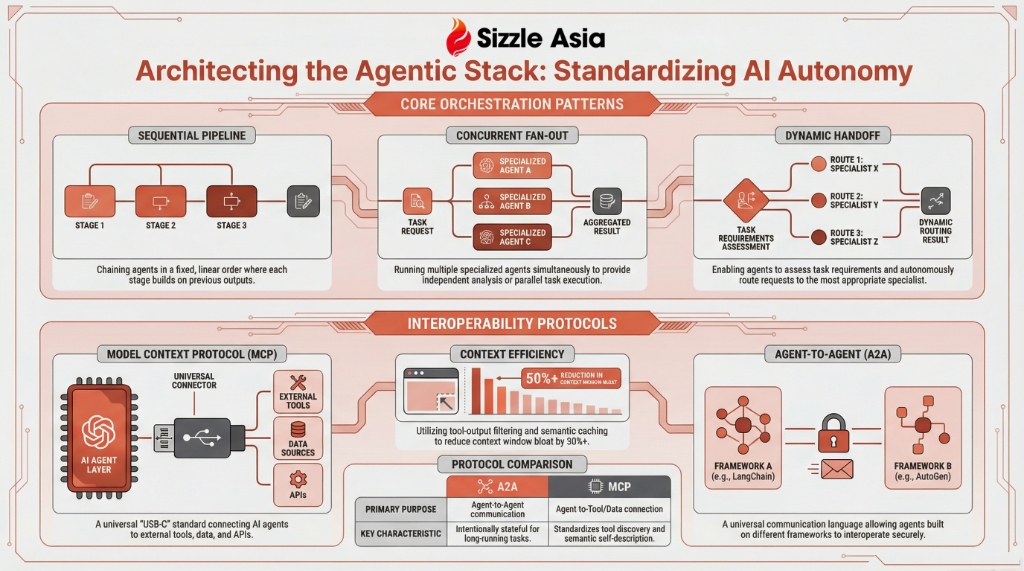
Infographic — A production-ready agentic AI stack: control plane → orchestration → tools → evidence → economics.
"The hardest part of agentic AI isn't the model. It's permissions, proofs, and predictable failure."
4) The Evidence Layer: Proof over Vibes
Journalists love stories; investors (and auditors) love proof. In agentic systems, proof is not just uptime—it is explainability at the action level.
You cannot debug an agent with text logs. You need Golden Trajectories. Platforms like LangSmith and TrueFoundry allow teams to capture "golden" traces of successful runs and use them as regression tests.
Every production run captures:
- The Plan: What the agent intended to do.
- The Tool Call: The exact JSON sent to the MCP server.
- The Evidence: The data retrieved that justified the decision.
Without an evidence layer, "agentic AI" is just an expensive rumor. When a finance agent declines a transaction, you must be able to replay the trace to prove it wasn't a hallucination.
5) The Economic Layer: Killing the "Quadratic Cost"
Autonomy is hungry. A single user request might trigger a "Reflexion loop" that runs for 10 cycles, consuming 50 times the tokens of a single linear pass. This is the Quadratic Cost of Agentic AI.
The best teams treat cost as a first-class architectural constraint via Agentic Plan Caching (APC). Instead of reasoning from scratch every time, the system caches successful plans for similar queries (e.g., "How to pull a Q3 earnings report").
- The Result: Research shows APC can reduce costs by over 50% and latency by 27% by reusing structured thoughts rather than regenerating them.
"Most agent deployments fail the same way: the toolchain scales faster than the controls."
What this means
The headline story is no longer "AI agents exist." The story is that companies are learning to operationalize delegated decision-making. We are watching the rise of a new enterprise layer: Agent Operations.
The winners will look boring to the outside world. They will have disciplined identity governance (Scope 1-4), clean tool contracts using MCP, and boringly predictable costs via plan caching. But that boring discipline is exactly what turns a stochastic novelty into critical infrastructure.